
The Lions play on Irish soil for the first time in history when they take on Argentina at the Aviva Stadium on June 20th – a site that is no stranger to Anglo-Irish sporting conflict.
The fact that a record-breaking 15 Irish players were named in the 2025 British and Irish Lions squad, coupled with their sole pre-tour friendly taking place at Dublin’s Aviva Stadium, is a testament to the progressive relationship and harmony that exists currently between the UK and Ireland in modern day sport and competition.
But it wasn’t always like this.
Saturday 15th of February 2025 marked the 30th anniversary of the Lansdowne Road football riot, a friendly match which took place between the Republic of Ireland and England on the same ground upon which the Aviva Stadium sits currently. After many reports of anti-Irish sentiment from away fans in the build-up to kick-off, the game got underway but was forced to be abandoned midway through the first half due to the violent conduct and unruly behaviour of a section of the travelling England fans, whom after Ireland took a 22nd minute lead began throwing missiles and debris from the away stand endangering hundreds of spectators occupying the lower stands below.
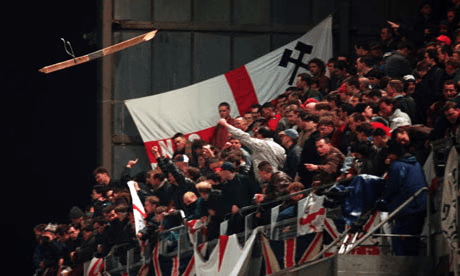
It was an event that organisers had hoped would unite these two rival nations, at a time when tensions were high following years of violence during the Troubles. What was intended to be a showcase of sport being utilised as a tool to promote peace and healthy competition unfortunately descended into a display of devastating disarray, with parts of the stand and benches being torn from the terraces before being hurled hazardously at the home crowd. The referee was left with no choice but to end the game early with just 26 minutes of football played – much to the dismay of goalscorer David Kelly, who had just netted arguably the biggest goal of his career to give Ireland an early first-half lead.
“The thing with that game was that I’d had a couple of chances just previously. I hadn’t had the fortune of putting them away, but as all strikers will say, you just keep going and the next opportunity is going to come..I was very fortunate that David Seaman had slightly got his angles wrong and the ball went underneath his arm” said Kelly, who was born in England but qualified for Ireland via his father who was from Dublin. “It was a brilliant moment for me and we ran off over to the left-hand side of the stadium and celebrated with all the players. It was a fantastic feeling.”
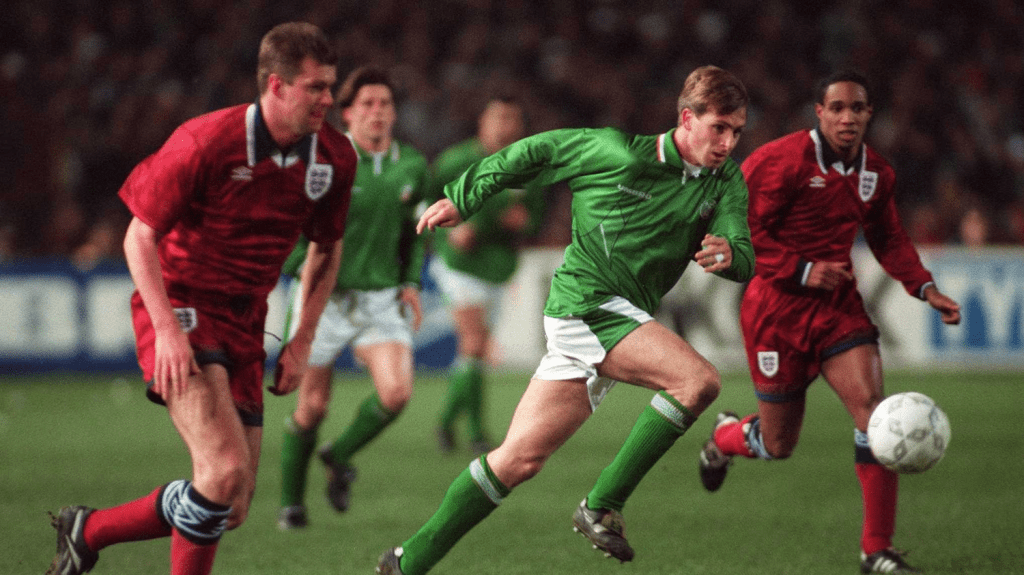
A fantastic feeling it was, but one that quickly fell flat as Kelly and the rest of the players on the pitch began to realise that something horrific was rapidly unfolding around them.
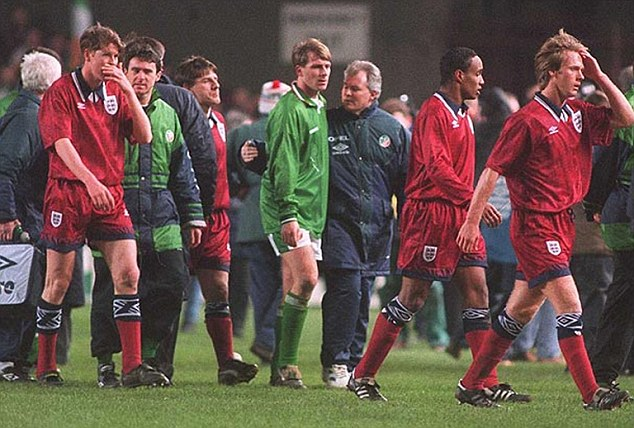
“There was debris starting to land on the pitch, I remember saying to David Platt, the England captain, I think we need to get off here. We looked at each other and then it became apparent..everybody was frantically running around on the touchline, and then Jack (Charlton) started to come onto the pitch – we just knew for a while that, and I’ll choose my words carefully here, but it was the start of a sh*tshow.”
Warren Barton made his England debut in that game and would go on to become the most expensive defender in English football later that year when he moved to Newcastle United from Wimbledon for a reported £4 million fee. The 25-year-old was thrust into the England starting XI by manager Terry Venables and was excited to make his international debut in such an historic fixture.
“It was supposed to be my proudest moment, I had been in Terry’s squad for probably 6 or 8 months, been on the bench but never quite got on against Norway, Nigeria, Columbia…but then Terry said, I’m going to play you in Lansdowne Road, it’s going to be a hostile environment but a passionate affair. We went in there in good faith, it had been a number of years since England played over there. Jack Charlton had them playing great football and it was supposed to be a special occasion of bringing the two teams together to celebrate building our friendship, sport has a way of doing that.”
Barton recalls his immediate concern for his family as nasty scenes began to unravel around the stadium.
“I was on the other side of the field, my first thought was my family underneath where the fans were, but the Irish authorities were great and made sure everyone got out. It was so disappointing, it felt like we were making big strides as fans travelling around but these weren’t true fans, they were just hooligans who went out there to cause trouble. It was really disheartening..it was my first cap, I wanted it to be remembered for a lot of other things.”
Conor Beatty, a then 19-year-old from Galway City was in the stadium that night along with his 16-year-old brother Alan, for what should have been one of the highlights of their footballing memories as fans growing up in the West of Ireland. He recalls the tension that was tangible across the town and terraces that night.
“I remember heading up on the bus, we were all in good spirits, everyone saying we’ve got a great chance here. It was a full house more or less, but my first recollection was when we hit Dublin – the tension around that day, you could cut it with a knife, like you knew there was something in the air around the streets about an hour before kick-off.”
Thirty years on, Conor still remembers the elation of Ireland taking that early first-half lead, followed by the fear and chaos that ensued.
“The atmosphere was electric, hairs on the back of your neck stuff. We were playing them off the pitch. Kelly scores on 22 minutes, then they had a goal given offside and everything kind of erupted after that. We could see pieces of wood being thrown from above – we were in the North Terrace to the left of where it was happening, and the schoolboys’ terrace was nearby as well. It was scary stuff, everyone in the ground fairly scattered out, everything closed down in Dublin then afterwards but we got back to our hotel safely thank god.”
Scary scenes indeed, thankfully never to be repeated between these two rival nations. Though it took 18 years until the sides met again in a 1-1 friendly draw at Wembley, the violence and chaos of that day remain firmly in the past, with the two nations meeting several times since on either side of the Irish Sea in what have continued to be peaceful occasions focused on football and on celebrating an age-old rivalry. That said, more recent encounters have been far less competitive from a scoreline point of view, which Kelly acknowledges have become a much more one-sided affair in comparison to his time playing for his country.
“I think there’s a vast difference there between the quality of both squads. It’s fair to say that we had a team around about Jack’s time that was very, very competitive and it didn’t matter who we were playing against. We’re not as competitive as we used to be..I still support the lads and cheer the team on, but we have a different quality and that’s not being critical of anybody or anything. It’s just the fact of what it was when we had Aldridge, Cascarino, Townsend, McGrath, Roy Keane, all these types of players within that group that made a team out of a national team.”
While that gap continues to exist on the football pitch, the rivalry between these two nations has been much more evenly matched on the rugby field with the scales tipping in Ireland’s favour in recent years following 5 victories from the last 6 encounters between the two sides. All eyes will look to Andy Farrell’s first Lions squad selection on June 20th where a record Irish cohort are expected to feature in Dublin, before departing for Australia ahead of their first test on June 28th in a clash against Western Force at Perth’s Optus Stadium.
 Paul Madden